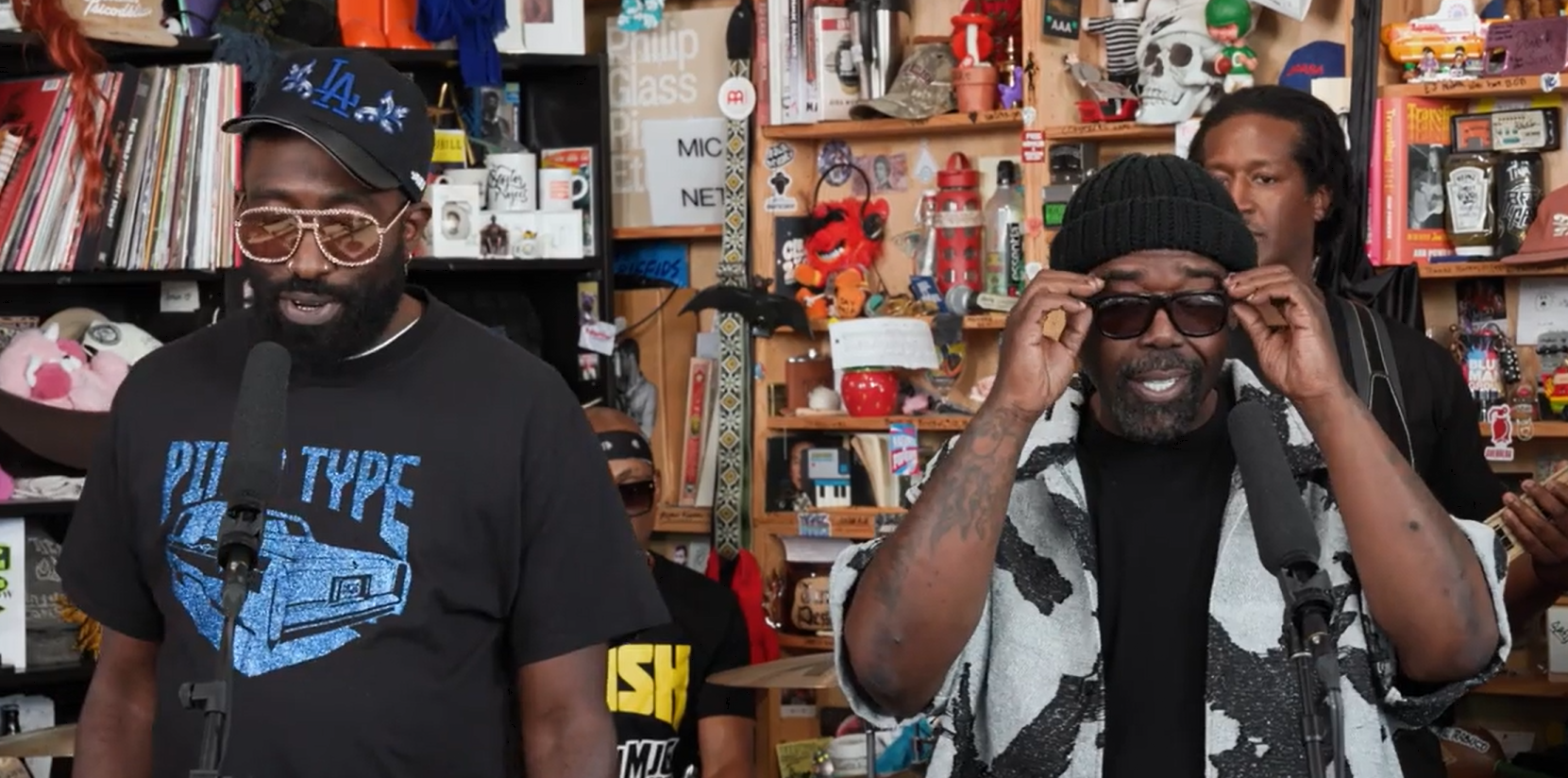
Every generation inherits an old school. For a lot of us, it was the music our parents played on Sunday mornings and Friday nights — the records that filled the house before we were old enough to choose our own. We learned those songs by osmosis, rolled our eyes at some of them, and only understood years later what they actually meant.
Then something quietly shifts. The music we grew up on — the music we called new, the music that felt like ours and no one else's — becomes the old school for the generation behind us. When 8Ball & MJG settled in behind the Tiny Desk, that shift stopped being an abstract idea. It became something you could watch happen in real time.
The new old school
8Ball & MJG started in Memphis in 1993. For anyone who came up in the late '90s and 2000s, their music wasn't heritage — it was the soundtrack of being young. It was the car, the cookout, the party. It was current. Now, three decades later, that same music carries the weight of a canon. It is studied, sampled, and revered the way we once revered the soul and funk records our parents wouldn't stop playing.
This is the formation of the new old school. The era we lived through has matured into the era we now protect. And the strange, beautiful thing about it is that the artists are still here — still performing, still in good health, still standing behind the music that defined a generation. We do not have to imagine what they were like in their prime. We can watch them do it at the Tiny Desk.
Filling the generational gap
What the Tiny Desk format does so well is collapse the distance between eras. A younger listener who knows 8Ball & MJG only through a sample, a TikTok, or a parent's playlist gets to see the source — live, unfiltered, with a band. An older listener gets to feel the music return to them with the gravity it has earned. The performance becomes a bridge between the people who were there and the people discovering it for the first time.
That bridge is how a canon forms. Old school doesn't become old school by accident. It happens when one generation passes the music down deliberately — when we play it for our kids, explain why it mattered, and insist that they understand it. The same way our parents did with us. The cycle doesn't break. It just adds another layer.
Why it matters
The set itself honoured that arc. The band opened with a few bars from "Pimps" before moving into the title track from 1993's Comin' Out Hard, played three songs from 2004's Living Legends, and closed with "Space Age Pimpin'." Debut, peak, and signature — the whole story of an era in a handful of songs. And the live instrumentation, rooted in the blues, drew a straight line back to the music that came before them. The chain is unbroken.
Part of NPR's Black Music Month programming celebrating the legacy of BET, the performance landed as more than a concert. It was a generation watching its own youth become history — and realizing, maybe for the first time, that we are now the ones holding the old school. The music we grew up on is the music we are responsible for passing on. 8Ball & MJG behind the Tiny Desk was the moment that truth became impossible to ignore.